
Losing a tooth is annoying in ways people don’t expect. Food gets stuck. You start chewing on one side without noticing. And in photos, you smile with your lips closed. Sooner or later, most people start asking the same thing. What do I put in that gap?
Two answers come up again and again: an implant or a bridge. Both work. Both have their good and bad sides. This blog walks through the dental implant vs bridge question in plain words, so you walk into your appointment already knowing what to ask.
What Are Your Missing Tooth Replacement Options, Really?
When people look up missing tooth replacement options, they usually find three names. A removable denture, a bridge and an implant. Dentures still have their place, especially when many teeth are gone, but for one or two missing teeth, most patients end up choosing between the other two.
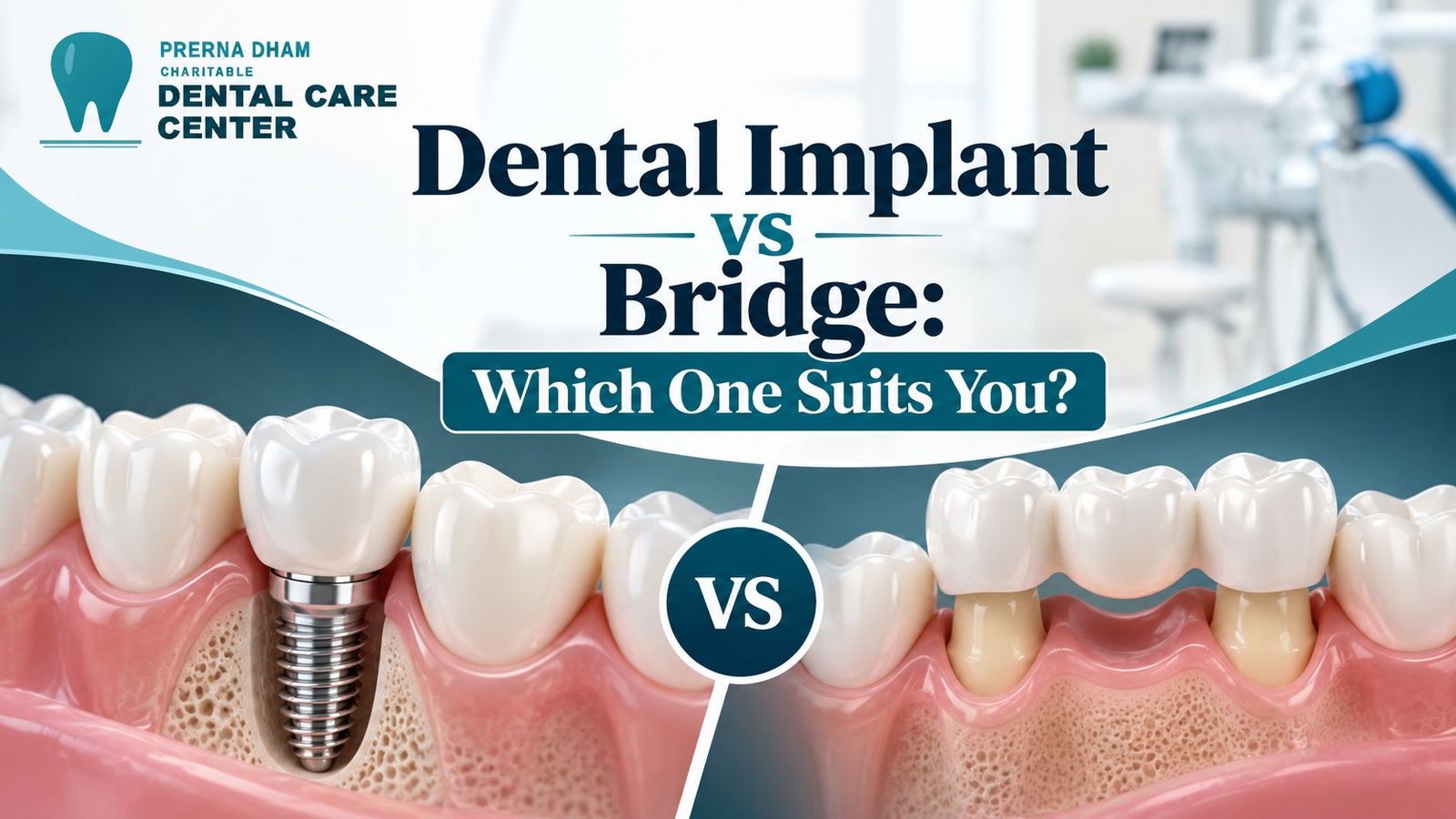
A bridge is basically a false tooth held in place by the teeth on either side of the gap. Those two neighbouring teeth are filed down a little, covered with crowns, and the false tooth sits between them like a small bridge over a river. Hence the name.
An implant is different. A small screw-like post goes into the jawbone where the root used to be. Once the bone grows around it, which takes a few months, a crown is fixed on top. It stands on its own. Nothing leans on the teeth beside it.
That’s the simple version. The details are where the choice gets made.
Dental Implant vs Bridge: The Honest Differences
Here is how the dental implant vs bridge comparison usually plays out in the clinic, though every mouth is a little different and the dentist will look at yours before suggesting anything.
- Time: a bridge can be done in a couple of visits over a week or two, while an implant takes a few months from start to finish because the bone needs time to heal
- The teeth next door get filed for a bridge, and that’s permanent; with an implant they are left alone
- Cost upfront is usually lower for a bridge. Implants cost more at the start
- Implants need enough healthy bone. If the bone has shrunk, some extra work may be needed first
- A bridge doesn’t involve any surgery, which matters a lot to some patients
Neither one is the “right” answer for everybody. A person in their sixties with crowns already on the neighbouring teeth might be happier with a bridge. Someone younger with perfectly healthy teeth on both sides may not want those filed down at all.
What about the bone?
This is the part many people don’t know. When a tooth goes missing, the bone under that spot slowly starts shrinking, since nothing is pressing on it anymore. An implant sits in the bone and keeps it working. A bridge rests on top of the gum, so the bone underneath can still thin out over the years.
Does getting an implant hurt?
It’s done under local anaesthetic, so you feel pressure, not pain. Most patients say the soreness afterwards was less than they expected. A few days of soft food and that’s about it.
How Long Does a Dental Bridge Last?
Probably the most common question we get about bridges. How long a dental bridge lasts depends a lot on how you look after it, but a well-made bridge can go on for many years. Ten years or so is common. Some last well beyond that.
The weak spot isn’t usually the bridge itself. It’s the teeth holding it up. Food and plaque can collect under the false tooth, and if cleaning slips, decay can start at the edges of the supporting crowns. Once that happens, the whole bridge may need to come off. Sometimes a supporting tooth gets decayed deep enough that the nerve is affected. In that case, root canal treatment in Faridabad might be needed to save that tooth before a new bridge can go back on.
Implants, if cared for, often last a very long time. Many people keep them for life, although the crown on top may need changing after a number of years. So when patients compare how long a dental bridge lasts against an implant, the implant usually wins on lifespan, even if it costs more at the start.
Which One Makes More Sense for You?
There’s no quiz that settles this. But a few things usually point one way or the other.
A bridge might suit you better if the teeth beside the gap already have big fillings or crowns, if you want the job done quickly, or if surgery of any kind makes you nervous. Also, if the budget right now is tight. An implant might suit you better if the neighbouring teeth are healthy and you’d rather not touch them, if you want something that feels closest to a real tooth, and if you’re thinking long term. Smokers and people with some health conditions may need extra checks before an implant, so be open with your dentist.
Honestly, a lot of patients come in and are sure about one option and leave preferring the other after seeing their X-ray. “That’s fine. That’s why a proper check matters before you decide among the missing tooth replacement possibilities in front of you.
Taking Care Of Your Choice
The big one with the bridge is scrubbing under the artificial tooth. Regular floss doesn’t go through easily; therefore, a floss threader or a little interdental brush is useful. Takes a minute longer at nite. It’s worth it.
With an implant, brush and floss like it’s your own tooth. Regular checkups let the dentist keep an eye on the gum around it, since gum infection is the main thing that can cause trouble later. For both, avoid using your teeth to open packets or crack hard things. Sounds obvious. People still do it.
Getting It Done at Prerna Dham
At Prerna Dham Charitable Dental Care Center, Dr. Munish Kalra looks at the gap, the teeth around it, and the bone before suggesting anything. You’ll get the pros and cons of both, in plain words, and the time to think it over.
If you’re leaning towards an implant, you can read more about dental implants in Faridabad on our page first. And if you’re still stuck on the dental implant vs bridge decision, just come in for a chat. No pressure to decide on the same day.
FAQs
Which is cheaper in the dental implant vs bridge choice? A bridge usually costs less at the start. Over many years, though, an implant can work out similar or even better value since it tends to last longer.
How long does a dental bridge last if I have gum problems? Often less, because weak gums and bone can loosen the supporting teeth. Getting the gums treated first gives the bridge a better chance.
Are dentures still one of the missing tooth replacement options worth thinking about? Yes, especially when several teeth are missing. They’re removable and cost less, but many people find fixed options more comfortable.
Can I get an implant years after losing a tooth? Often yes. If the bone has thinned a lot, a small bone graft may be needed first.